
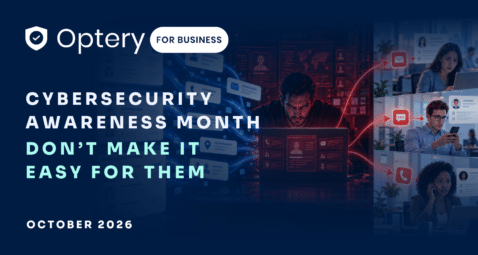
Cybersecurity Awareness Month 2026 has a simple message: “Don’t Make It Easy for Them.” The National Cybersecurity Alliance is encouraging people and organizations to build security habits that make life more difficult for cybercriminals.
NCA recommends four simple steps: use strong passwords and a password manager, turn on multifactor authentication, recognize and report scams, and keep software updated.
Each makes an attacker’s job more difficult. But exposed employee data can give attackers a way around these defenses.
Personal information can help attackers crack or reset passwords, impersonate employees to bypass authentication or account-recovery processes, and build phishing, smishing, and vishing campaigns that can get past security awareness training. Just as organizations patch exploitable software vulnerabilities, they should also address exploitable employee data that threat actors need to identify employees and executives, map relationships, develop convincing pretexts, impersonate trusted people, and reach targets through email, phone, and text.
For security teams, that means looking at the personal and professional details exposed through data brokers.

Data Brokers Make Attacker Reconnaissance Easy
Before launching a targeted social engineering attack, threat actors research the people inside an organization. They look for information that can help them identify valuable targets, understand roles and relationships, establish credibility, and determine the best way to reach them.
Data broker and people-search sites make this information readily available, including phone numbers and email addresses, job titles, associates, and other personal and professional details.
Attackers have been documented using these sites to identify and profile employees, map organizations, and support targeted social engineering campaigns. Threat actors use the information for phishing, smishing, and vishing, executive impersonation, account takeovers, help desk manipulation, and to threaten personnel and their families.
The more exposed an organization’s employees are, the more options attackers have. Greater exposure means more possible targets and avenues of compromise, additional contact channels and impersonation opportunities, and more ways to get into the organization.
Security Teams Are Moving Upstream
Strong passwords, multifactor authentication, security awareness training, email security, and other controls remain essential. But they do not remove the personal and professional information attackers use to research and target employees in the first place.
Security teams are recognizing this and moving upstream to address employee data exposure.
Optery’s 2026 Enterprise Social Engineering Survey Report found that 96% of cybersecurity leaders surveyed had seen targeted social engineering increase over the previous 12 months. The attacks are reaching employees across multiple channels, while 52.7% of respondents said the volume is creating increasing strain or overwhelming existing defenses.
Respondents ranked data broker and people-search sites as the most significant source of attacker intelligence, ahead of social platforms and breach data, and ranked reducing publicly exposed employee data as both the most widely used defense and the top investment priority for social engineering defense.
More than half of respondents, 53.9%, reported having a broad program to reduce exposed employee data, while another 38.7% reported programs focused on specific roles. And 76.5% categorized reducing publicly exposed employee data as either a core security initiative or supporting security measure.
At the same time, most organizations have not yet extended personal data removal across the full workforce. Only 14.0% reported full-workforce coverage, while 82.2% said they plan to expand personal data removal coverage in the next 12 months.
The case for expanding coverage is straightforward: if exposed employee data is helping attackers identify, profile, and target people inside organizations, reducing that exposure can help prevent attacks before they begin.
Minimize the Data Attackers Rely On
Personal data removal reduces the information available to attackers for reconnaissance and targeting.
For organizations, that means identifying employee exposure across data broker and people-search sites, removing exposed personal and professional information, and continuing to monitor for new or republished exposures.
It also means following the risk. Executives are important targets, but they are not the only ones. Optery’s 2026 survey found IT and identity-focused employees were targeted most frequently, followed by HR, Finance, executives, and Help Desk personnel. Organizations need to address exposure across these high-risk roles and, increasingly, the broader workforce.
Optery for Business helps organizations find and remove exposed employee personal and professional information from data broker and people-search sites at scale. Optery’s patented search technology typically finds ~100 exposed profiles per person, including ~40-50 missed by competitors, while before-and-after screenshots and exposure reduction metrics give security teams visibility into progress.
Don’t Make It Easy for Them
Cybersecurity Awareness Month encourages everyone to take simple steps that make life harder for cybercriminals.
For security teams, that should include looking at the information attackers can find about the people inside their organizations.
Don’t make reconnaissance easy for them. Minimize the exposed data they rely on to target your people. Start a free 30-day trial of Optery for Business to identify and remove exposed personal data for high-risk employees.